How Long Connecticut Probate Takes When There's a House
Most people learn what a fiduciary is about a week after they bury a parent.
That's the word Connecticut uses for the person the court puts in charge. It landed on you along with a folder, a house nobody's living in and a family with questions you can't answer yet.
Probate Is a Checklist on a Clock
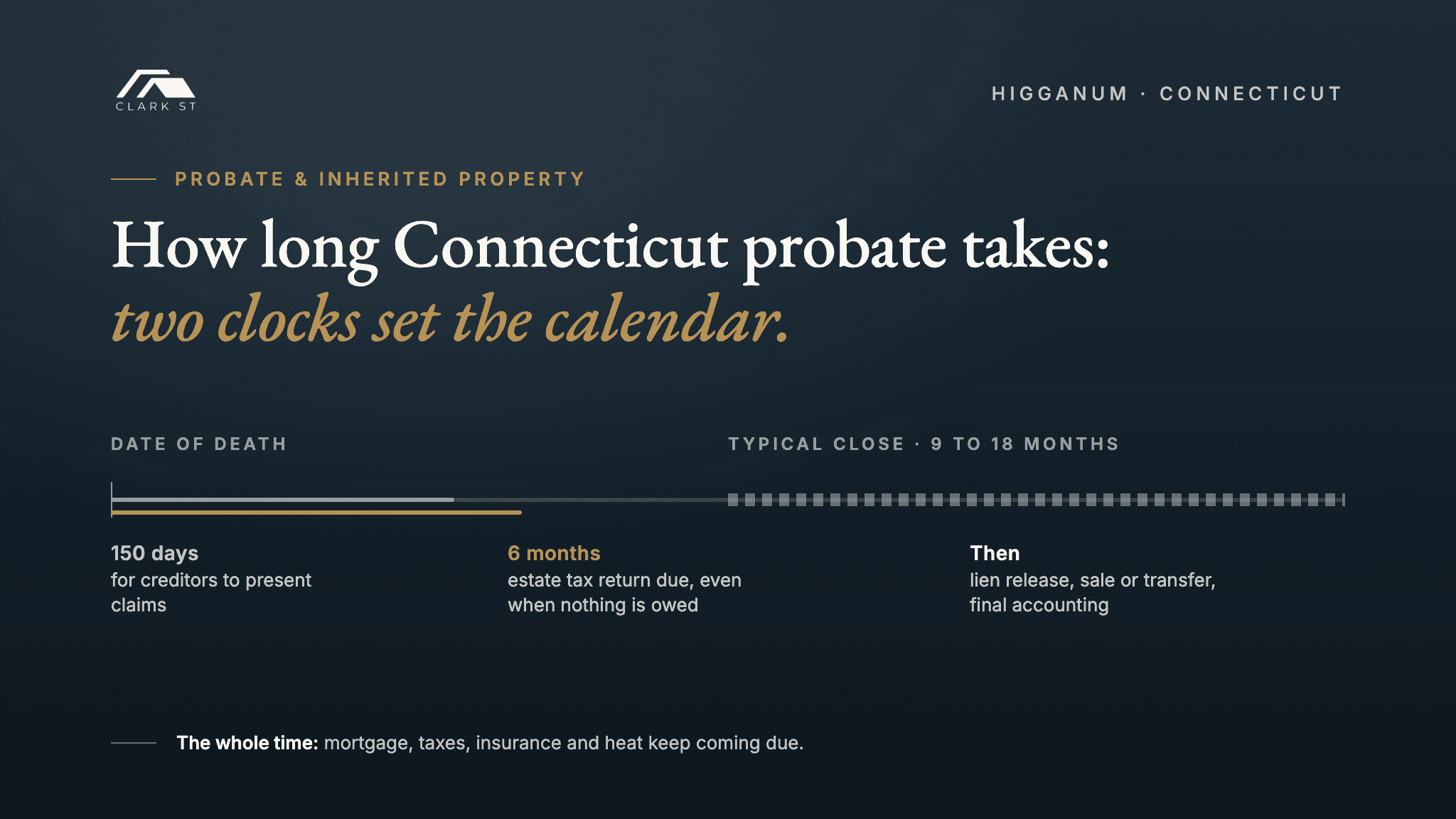
For a straightforward estate with a will and a house, probate is a sequence of filings with two timers running.
- Timer one: creditors get 150 days from the day the court appoints you to present claims against the estate.
- Timer two: the estate tax return is due 6 months from the date of death.
How long it takes comes down mostly to those two timers. Nothing closes until both run out. That's why an estate holding real estate typically takes 9 to 18 months, even when everyone gets along and every form goes in on time.
The Steps, in the Order They Happen
- File the will within 30 days of death. Whoever is holding it delivers it to the Probate Court for the district where your parent lived. This is required even if no formal probate follows. The obligation lands on whoever physically has the will, not on the executor. Connecticut attaches a real penalty to missing it: up to a $1,000 fine and up to a year in prison. Most families have never heard of this deadline. Find the will early.
- File where your parent lived, not where the house sits. Connecticut has 54 probate districts. The right one is the district where your parent lived.
- Open the estate. The named executor files a Petition for Probate of Will. If no named executor is able to serve, the court appoints an administrator instead.
- Get your Fiduciary's Certificate. The court reviews the petition, sometimes with a short hearing. It admits the will and issues the document that gives you legal authority to act. Until you have it in hand, you can't sell the house, close an account or sign anything for the estate.
- Notify heirs, beneficiaries and creditors. Everyone entitled to notice gets it, along with a copy of the will and the application. The court also arranges a newspaper Notice to Creditors. Skip proper creditor notice and you can be personally exposed to debts later.
- File the inventory within 2 months. Form PC-2407, Inventory/Decedents' Estates, lists everything your parent owned at fair market value. The house, the accounts, the vehicles, the personal property.
- Work the 150-day creditor window. You review claims, pay the valid ones from estate funds in priority order, then file a return of claims. Don't hand anything to the heirs until the debts are handled. Pay yourself or your siblings early and you can be personally on the hook for it.
- File the estate tax return within 6 months. Every Connecticut estate files, even when nothing is owed. For 2026 the exemption is $15,000,000 per person, with a flat 12% above that. The great majority of estates owe no tax. You still file Form CT-706 NT with the Probate Court. This filing is what frees up the house. Without that filing, the court won't release the lien and you can't sell.
- Clear the liens. Once the return is in, you petition the court for a Certificate Releasing Liens (form PC-205B). Then you either transfer title to the heirs on the land records or sell. A sale needs a power of sale in the will or the court's approval.
- Final accounting, distribution, close. You file an accounting showing every dollar in and out. The court approves it. You distribute what's left per the will, pay the probate court fee and file the closing affidavit. That fee is a sliding scale based on the size of the estate. It gets billed after the tax return is filed. Budget for it before you distribute the last dollar.
Why You Can't Sell the House Yet
At death, Connecticut attaches two liens to the property automatically.
One is for estate tax. The other is for probate fees.
You can't sell the house or cleanly transfer it until the estate tax return is filed and the court issues the lien release.
The Carrying Costs Never Pause
The court paperwork won't tell you this part.
The mortgage keeps coming due. So do the property taxes, the insurance premium, the electric bill, the water bill and the oil or gas that keeps the pipes from freezing. For the full 9 to 18 months.
Somebody has to pay all of it. Either the estate pays or the heirs pay out of pocket. If nobody does, the house gets damaged, the bank forecloses or the coverage lapses.
This is where inherited houses lose money. A mortgage payment here, a tax bill there, month after month, while everyone waits on a court date. Add it up over a year and it's a real number that nobody budgeted for.
Call the insurance company this week. A standard homeowner's policy often voids once a house sits vacant. If nobody is living there during probate, you need vacant property coverage. One burst pipe in an empty house in February can do serious damage. Vacant coverage costs more than the old policy. Pay it anyway.
Get a date-of-death appraisal now, while you're doing the inventory. You need the number for PC-2407 anyway. It also does a second job, explained below.
If it's a rental property, you just became a landlord. Rent flows to the estate, not to the heirs personally. Leases stay in force, security deposits transfer and tenant rights continue. You're running a small business while you settle an estate. Plan for that.
The Step-Up in Basis Is the Good News
The cost basis on the house resets to its value on the date of death. If your parents bought it for $90,000 and it's worth $400,000 now, the heirs inherit at a $400,000 basis. Sell anywhere near that number and there's little to no capital gains tax on the sale.
The date-of-death appraisal is what proves it. Get one immediately.
What This Looks Like With Real People in It
A husband and wife from Essex came to us through a friend in 2021. The wife, Diane M., had inherited her father's house in Wethersfield. It needed a full cleanout and more work than they could take on before it would ever sell on the open market.
We were there within 24 hours, walked the property and gave them a written offer that afternoon.
Before anything else happened, we asked Diane to walk through and pull every single thing she wanted to keep. We helped move it to her place in Essex. After we took ownership, the team sorted what was left into three piles.
- Obvious garbage.
- Things worth donating to Habitat for Humanity and other local charities.
- And anything that looked like it might have meant something to somebody. We held that pile aside and didn't touch it until Diane came back through one last time and told us it was okay to let it go.
Not every one of these is that straightforward.
We spent 42 months on a probate in Higganum. Herbie called us from Texas thinking he was the only heir. The title search turned up eight more. Covid closed the courts a month in. We closed in April 2023.
Herbie hugged our team at the closing.
The Real Decision: Keep or Sell
Once the estate clears, you have a decision. This is where most family conflict actually lives.
Keep it. Someone has to run it. That works if one person genuinely wants the house and can carry it. It stops working when nobody will handle the roof.
Buy the others out. This works when one heir wants it and can either qualify for financing or has the cash. Get an appraisal everyone agrees to first, before anybody says a number out loud.
List it with an agent. This is a real option and often the right one. If the house shows well, the estate can carry it a few more months and nobody needs the money by a specific date, listing it will usually bring the highest number. Add the time to list, find a buyer and close on top of the probate timeline. Use an agent who has actually worked an estate sale. A conventional agent can commit to a closing date the court won't honor.
Sell it directly. This fits when the house needs work nobody wants to fund. It also fits when the heirs are spread across the country, when there are tenants or when the carrying costs are what everyone's actually arguing about. You take a lower number than a finished house would bring on the open market. In exchange, you get no repairs, no cleanout, no showings, no commission and a set closing date.
We walked through how that sale works, start to finish, in Selling a Probate Property in Connecticut.
There's no shame in selling. Carrying costs, distance, tenant headaches and family friction are real reasons.
How to Read Your Own Situation
You haven't been appointed yet. Nothing else matters this week. Find the will, file it and get the petition in. You have no authority until you hold that certificate.
The house is empty right now. Call the insurer today and ask about vacant property coverage. Then turn the heat on and have somebody check the place weekly.
You're paying the bills out of your own pocket. Write down every dollar. It can come back to you through the estate accounting, but only if you can document it.
The family is already arguing. The argument is almost always keep or sell. It's usually happening before anyone has an appraisal. Get the number first, so everybody is looking at the same figure.
You want it done and over with. Say that out loud to whoever is advising you. It's a legitimate goal. It changes which path makes sense.
Before You Act on Any of This
I'm not an attorney or an accountant. This isn't legal or tax advice. Talk to your attorney, accountant or financial advisor before you make any probate decisions.
Forms get revised, deadlines get amended and every estate has its own facts, including the 2026 exemption figure above. Make sure you run your specifics past a Connecticut probate attorney and check the Probate Court's own site at ctprobate.gov.
About Ed Mathews and Clark St Homes
Ed is the founder of Clark St Homes, based in Higganum, Connecticut. He has been helping homeowners since 2011. He and his team help people work through difficult situations: foreclosure, probate, inherited property, divorce, tired landlords and houses that needed more work than a conventional sale could handle. Clark St serves homeowners, landlords and executors across Hartford County and Middlesex County, as well as Guilford and Madison.
Situations we help with
- Behind on payments or facing foreclosureHow foreclosure works in Connecticut and what you can still do about it.
- Inherited a house or handling probateSelling an inherited Connecticut house without fixing it up first.
- Done being a landlordSelling a Connecticut rental, occupied or vacant.
- Why a cash offer comes in below ZillowWhere the difference goes, from repairs to commission, and when listing is the better call.
- How long closing takesA cash sale skips the bank, but title still takes time. Why most closings take 2 to 4 weeks.
- Leaving the house as it isTake what matters to you and leave the rest. No dumpsters, no estate sale.
- Free guide: Facing Foreclosure in Connecticut14 pages: what actually happens, the one deadline most homeowners miss and every real option you still have.
Get Your Cash Offer
No fees. No commissions. No repairs.