
Selling a Probate Property in Connecticut
Losing someone is hard enough. Then you find out there's a house involved, and suddenly you're dealing with courts, attorneys, appraisals and paperwork while you're still grieving.
This is one of the most common situations we see in Connecticut. Most executors don't know what they can and can't do until they're already in the middle of it.
What Probate Means for Real Estate
In Connecticut, the local Probate Court oversees everything from validating the will to authorizing the distribution of assets, including real estate.
If there's a will, the named executor is in charge. If there's no will, the court appoints an administrator. Either way, real estate cannot be sold or transferred without court involvement. The property doesn't belong to the heirs to do with as they please. It belongs to the estate, and the estate is under court supervision until everything is resolved.
Can You Sell a Home That's in Probate?
Yes. But there are steps you have to take before a sale can happen.
If the will grants "full powers" to the executor, they may have authority to sell without a separate court approval. But that's not the common case. Most probate sales in Connecticut require the executor or administrator to petition the court before the property can be listed or transferred.
Get appointed first. The executor or administrator files the estate with the local Probate Court and receives Letters Testamentary or Letters of Administration. This document is what gives them legal authority to act on behalf of the estate. Without it, they can't sign anything.
Petition the court to sell. Once you have a signed purchase agreement, the executor files form PC-400, Petition to Sell or Mortgage Real Property, with the Probate Court. The petition includes the contract and evidence of the home's fair market value. Every heir gets notice and can ask for a hearing. If no one objects, the court can approve the sale without one.
Wait for approval. This step takes time. A few weeks is common. The court notifies interested parties, including heirs, and gives them an opportunity to raise objections. If anyone does, it gets more complicated.
Close. Once the court approves the sale, the closing proceeds. Proceeds stay in the estate until the court authorizes distribution to creditors and heirs. The executor doesn't get to hand out checks at the closing table.
Where It Goes Sideways
The most common mistake executors make is assuming they can move the property before they have the authority to do so. A well-intentioned family member who accepts an offer before the court has weighed in creates problems that take months to untangle.
The second most common mistake is paperwork. Missing a form, submitting an incomplete petition or missing a court deadline can add weeks to a process that's already slow. Connecticut Probate Courts are thorough and slow.
The third is hiring a real estate agent who doesn't understand probate timelines. A conventional agent who isn't familiar with the process can commit to a closing date the court won't honor. That frustrates buyers and sometimes kills the sale.
A Probate in Higganum
We worked on a probate situation in Higganum for 42 months.
Herbie called us from Texas. He thought he was the sole heir to his family's homestead, 58 acres that had been in the family for 150 years. The title search told a different story. The property had never gone through probate. When it finally did, eight more heirs turned up, people scattered across the country who hadn't spoken to each other in years. One lived in rural Appalachia with no phone. When the attorney needed his signature, a neighbor had to drive over and collect him.
A month after we started, Covid shut down the probate courts.
The house itself had a family living in it without permission, using the basement as a dump. We negotiated with them directly and worked out an arrangement, $700 a month for three months, so the kids could finish the school year before moving. We helped the nine heirs hire a local probate attorney. Paid back taxes. Managed the court backlog. Kept people who didn't particularly like each other pointed in the same direction for 42 months.
We closed in April 2023.
Most probate situations aren't that complicated. Some are. We stayed on that one until it closed.
What to Do If You're in This Situation
Talk to a probate attorney before you do anything else. Connecticut has specific rules. Whether there's a will, how many heirs there are and whether the property has liens or back taxes all change which steps come first.
Work with a real estate agent who knows probate timelines, or consider whether a direct sale is a better fit. If the property needs work, has tenants or has title complications, a conventional buyer's lender may not be able to get financing approved regardless of the sale price. In situations like that, the right buyer is one who doesn't need a lender's approval to close.
If you want to talk through your situation, we're here. We've closed a probate sale in Wethersfield in under 30 days, court approval included. We'll tell you what we think makes sense and refer you to the right people if a direct sale isn't the right call.
The conversation costs you nothing and you leave knowing where you stand.
Situations we help with
- Behind on payments or facing foreclosureHow foreclosure works in Connecticut and what you can still do about it.
- Inherited a house or handling probateSelling an inherited Connecticut house without fixing it up first.
- Done being a landlordSelling a Connecticut rental, occupied or vacant.
- Why a cash offer comes in below ZillowWhere the difference goes, from repairs to commission, and when listing is the better call.
- How long closing takesA cash sale skips the bank, but title still takes time. Why most closings take 2 to 4 weeks.
- Leaving the house as it isTake what matters to you and leave the rest. No dumpsters, no estate sale.
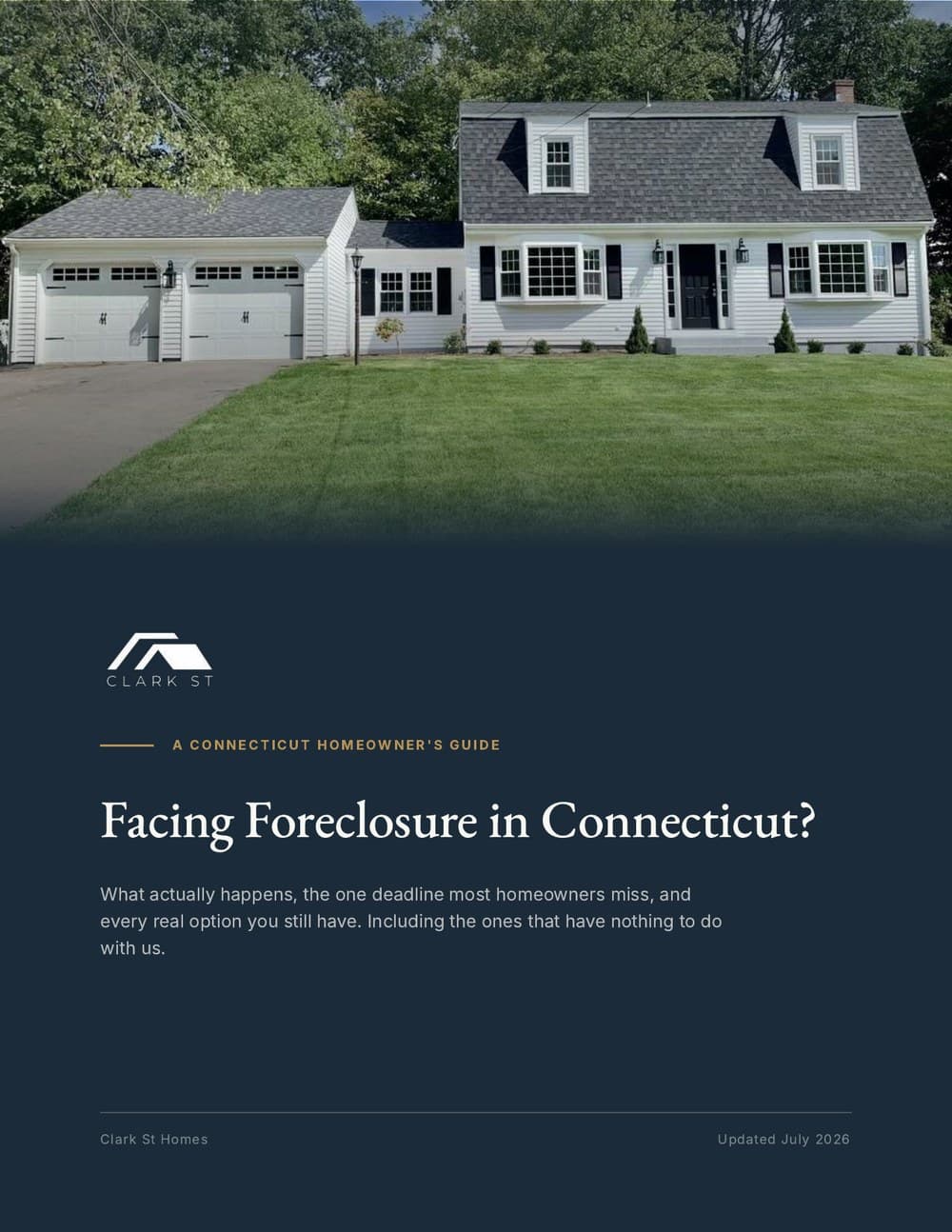
- Free guide: Facing Foreclosure in Connecticut14 pages: what actually happens, the one deadline most homeowners miss and every real option you still have.
Free guide
Facing foreclosure in Connecticut
A free 14-page guide: what actually happens, the one deadline most homeowners miss and every real option you still have, including the ones that have nothing to do with us.
Get Your Cash Offer
No fees. No commissions. No repairs.