
Understanding the Connecticut Foreclosure Process
Nobody calls us about foreclosure when things are going well. By the time the word comes up, something has already gone sideways, a job, a medical situation, a divorce, a stretch of months that added up faster than expected. The house is now caught in the middle of it.
Connecticut Is a Judicial Foreclosure State
In Connecticut, foreclosure goes through the court system. That makes the process slower and more formal than in states where lenders can foreclose without a judge. Slower isn't always bad when you're the homeowner. It gives you time to act, and time is the most valuable thing you have when you're behind on payments.
The Two Types of Foreclosure in Connecticut
Connecticut uses two methods. Which one applies to you changes what happens next.
Strict foreclosure is the more common of the two. The court sets a deadline called a Law Day. If the borrower hasn't paid the full amount owed by that date, ownership transfers directly to the lender. There's no auction. The lender takes the house.
Foreclosure by sale is used less often, typically when there's meaningful equity in the property or multiple lien holders involved. The court orders a public auction. Proceeds from the sale go toward paying off the debt, and anything left over goes to the borrower or other lien holders in priority order.
How the Timeline Works
The default. Federal rules generally bar a lender from filing for foreclosure until you're more than 120 days behind. You'll receive a Notice of Default, and the lender may reach out about loss mitigation options before going further.
Notice of intent to foreclose. Connecticut law requires lenders to give borrowers at least 60 days notice before filing a court action. This is a real window. Use it.
The lawsuit. If nothing gets resolved, the lender files in Superior Court. You're served as a defendant and have 15 to 30 days to respond. If you don't respond, the lender gets a default judgment.
Mediation. Connecticut runs a Foreclosure Mediation Program that pauses the court process and puts both parties in front of a mediator to explore alternatives, loan modifications, repayment plans, short sales. You have 15 days from the return date printed on your summons to file for mediation. That's a court date, not the day you were served. Missing that window means losing one of your best tools.
Court judgment. If mediation doesn't produce a resolution, or if you didn't respond to the lawsuit, the court issues a judgment. For strict foreclosure, the Law Day gets set. For foreclosure by sale, the auction date gets scheduled.
Law Day or auction. In strict foreclosure, if you haven't paid in full by the Law Day, the lender becomes the owner. In foreclosure by sale, the property goes to auction and the proceeds get distributed by the court.
Eviction. If you're still in the property after the foreclosure is complete, the new owner, usually the bank at that point, has to file for eviction through housing court. That's a separate process with its own timeline.
How Long Does It Take?
From the first missed payment through a completed foreclosure, Connecticut typically runs 12 to 18 months. The court backlog and mediation process both slow things down. For a homeowner with options, that time is worth using.
What Can Stop It
Paying what's owed stops it immediately if you can do it. A loan modification or refinance can restructure the debt and let you keep the house. Bankruptcy triggers an automatic stay that halts the foreclosure process, though it comes with its own consequences worth understanding before you file.
Selling the property is an option many homeowners don't fully consider until they're deep into the process. If you sell before the foreclosure completes, you control the terms. You choose the buyer, the timeline, the closing date. You walk away with whatever equity exists rather than watching the lender take the house and the court distribute what's left.
A short sale is possible when you owe more than the house is worth. It requires lender approval, takes longer and comes with its own complications. But for some situations it's the right path.
Act While You Have Time
The foreclosure timeline in Connecticut gives you more runway than most homeowners realize.
Every option you have gets smaller as time passes. Refinancing becomes harder when you're six months behind than when you're two months behind. Selling voluntarily becomes harder when there's a judgment than when you're still in the default phase. Mediation is only available during a specific window.
If payments have gotten hard to make and you're not sure what comes next, the time to look at your options is now, not when the Law Day is two weeks out.
We've worked with homeowners at every stage of this process. Sometimes the right answer is to sell quickly and walk away clean. Sometimes there's a better path and we'll tell you what we see. Either way, a conversation costs you nothing and you leave knowing where you stand.
Situations we help with
- Behind on payments or facing foreclosureHow foreclosure works in Connecticut and what you can still do about it.
- Inherited a house or handling probateSelling an inherited Connecticut house without fixing it up first.
- Done being a landlordSelling a Connecticut rental, occupied or vacant.
- Why a cash offer comes in below ZillowWhere the difference goes, from repairs to commission, and when listing is the better call.
- How long closing takesA cash sale skips the bank, but title still takes time. Why most closings take 2 to 4 weeks.
- Leaving the house as it isTake what matters to you and leave the rest. No dumpsters, no estate sale.
- Free guide: Facing Foreclosure in Connecticut14 pages: what actually happens, the one deadline most homeowners miss and every real option you still have.
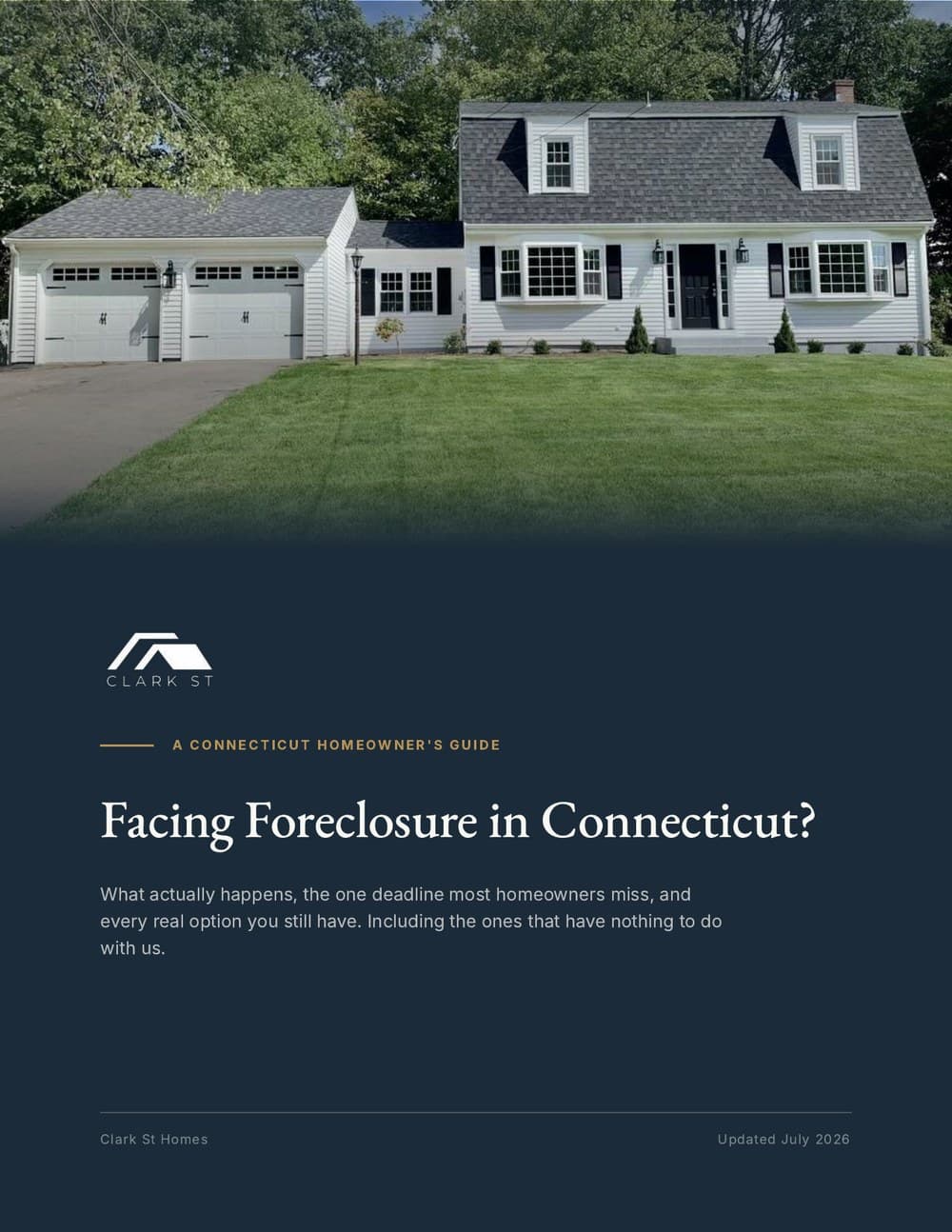
Free guide
Facing foreclosure in Connecticut
A free 14-page guide: what actually happens, the one deadline most homeowners miss and every real option you still have, including the ones that have nothing to do with us.
Get Your Cash Offer
No fees. No commissions. No repairs.